
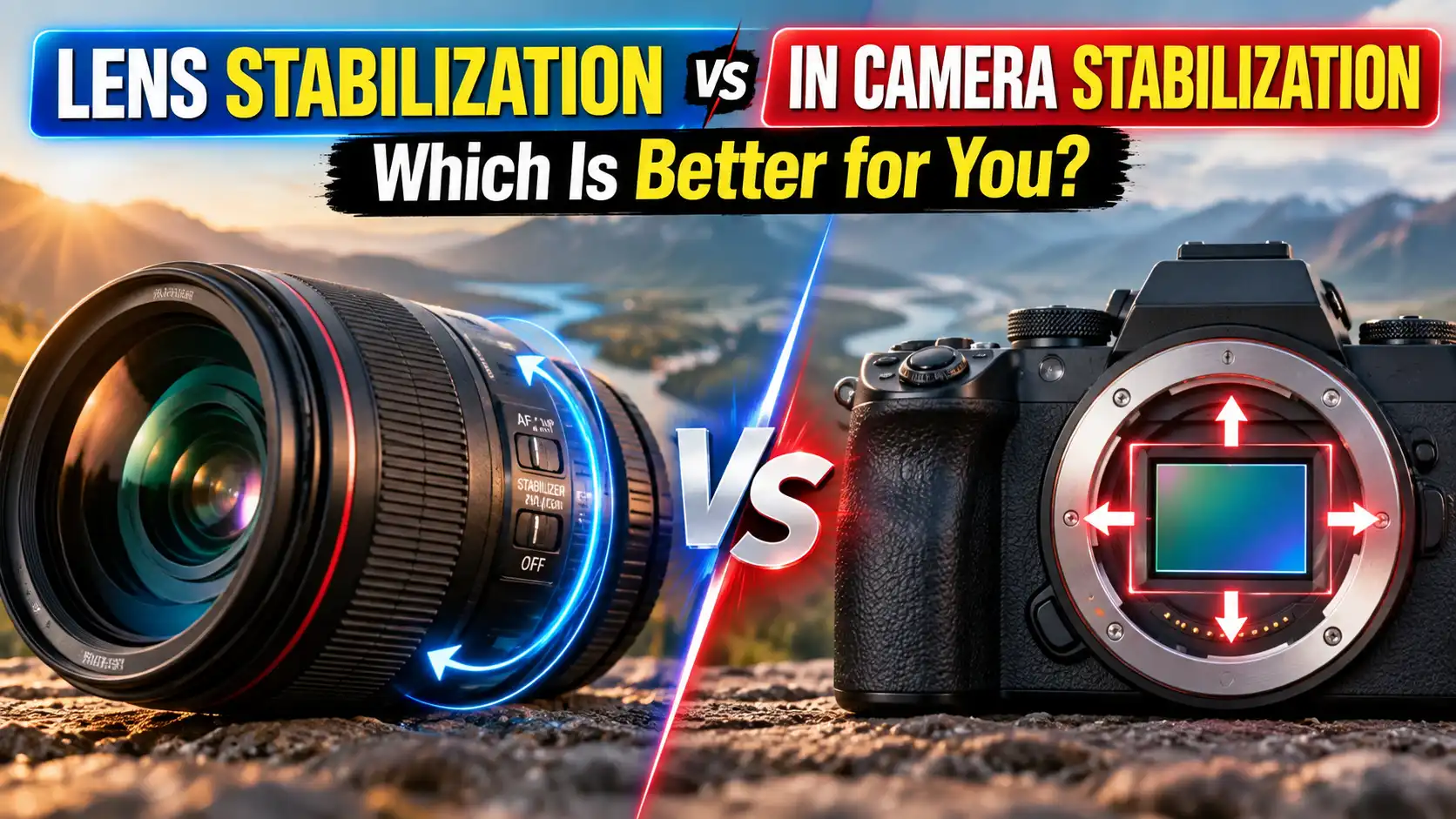
Blurry photos can ruin a great shot. When you shoot in dim light or hold your camera by hand, your hands shake. Even tiny hand shakes make your images soft and unclear. That is why camera stabilization is so important for every modern photographer.
When shopping for gear, you will face a big choice: lens stabilization vs in camera stabilization. Should you buy lenses that have built-in optical stabilizers? Or should you invest in a camera body that moves its own sensor to steady your shots?
Both tools solve the problem of camera shake, but they work in very different ways. Each system also impacts your gear budget and your shooting experience. This guide breaks down how both systems work, how they compare in cost, and which one fits your shooting style best.
Quick Answer
In the battle of lens stabilization vs in camera stabilization, neither is strictly better; they excel in different areas. In-camera stabilization (IBIS) stabilizes every lens you attach, including older prime lenses. Lens stabilization (OIS) works better on long telephoto lenses. For the sharpest handheld results, many modern cameras use both systems together.
What Is In-Camera Image Stabilization (IBIS)?
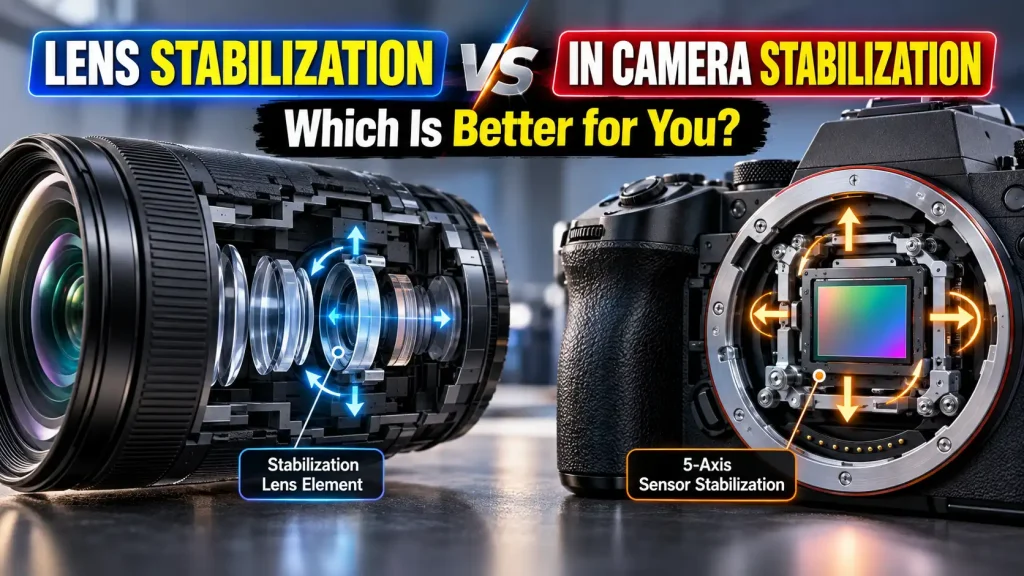
In-camera image stabilization, often called IBIS, lives directly inside your camera body. Instead of adjusting the glass, the camera moves the image sensor itself.
Inside the camera body, tiny electromagnets suspend the sensor unit. When you press the shutter, gyro sensors detect hand movement. The camera shifts the sensor in real time along multiple axes to counter that shake.
+-------------------------------------------------------------+
|                     CAMERA BODY (IBIS)                      |
|                                                             |
|         Pitch (Tilt Up/Down)      Yaw (Turn Left/Right)     |
|                   ^                         ^               |
|                   |                         |               |
|            +---------------+         +---------------+      |
|            |               |         |               |      |
|    <-------| SENSOR SHIFTS |-------> |  ROLL (TWIST) |      |
|    X-Axis  |  (UP / DOWN)  |  Y-Axis |               |      |
|            +---------------+         +---------------+      |
|                                                             |
|           Stabilizes ANY mounted lens at the sensor         |
+-------------------------------------------------------------+
Most modern IBIS setups offer 5-axis stabilization:
-
Pitch: Tilting up and down
-
Yaw: Turning side to side
-
Roll: Twisting clockwise or counter-clockwise
-
X-axis: Sliding left and right
-
Y-axis: Sliding up and down
The biggest perk of IBIS is universal use. Any lens you mount gets stabilized at the sensor plane. This includes compact primes, budget manual lenses, and vintage glass mounted with basic mechanical adapters.
What Is Lens-Based Optical Image Stabilization (OIS)?
Lens-based optical stabilization places floating glass elements inside the lens barrel. Camera brands use different names for this technology:
-
Nikon: Vibration Reduction (VR)
-
Canon: Image Stabilizer (IS)
-
Sony: Optical SteadyShot (OSS)
-
Fujifilm / Panasonic: Optical Image Stabilization (OIS)
When your hands shake, tiny gyro sensors inside the lens barrel track the motion. Floating glass elements shift rapidly in opposite directions to keep the projected light beam centered on the sensor.
+-------------------------------------------------------------+
|                      LENS BARREL (OIS)                      |
|                                                             |
|   Front Glass         Floating OIS Element        Camera    |
|     [  )    ------>        [ \ / ]       ------>  Sensor    |
|                            <--+-->                          |
|                       Shifts Up / Down                      |
|                       & Left / Right                        |
|                                                             |
|          Stabilizes the optical beam before the sensor      |
+-------------------------------------------------------------+
Because stabilization happens before the image reaches the camera, the view through an optical viewfinder (OVR) stays steady. This makes framing distant, fast-moving wildlife much easier on your eyes.
Lens Stabilization vs In Camera Stabilization: Key Differences
To pick the right setup, you need to understand how each system performs during everyday shooting.
       5-AXIS IBIS (Camera Body)           OPTICAL STABILIZATION (Lens)
  +---------------------------------+   +---------------------------------+
  | [x] Corrects rotational roll    |   | [ ] Cannot correct roll         |
  | [x] Works on all lenses         |   | [x] Tuned to exact focal length |
  | [x] Keeps prime lenses tiny     |   | [x] Calms optical viewfinder    |
  | [!] Struggles at 300mm+         |   | [x] Superb at long telephoto    |
  +---------------------------------+   +---------------------------------+
Performance Across Focal Lengths
Lens-based stabilization works best on telephoto lenses. At focal lengths of 200mm, 400mm, or 600mm, a tiny hand tremor creates huge motion blur. A floating lens element can make large corrective shifts tailored to that specific focal length. A sensor in a compact body cannot physically travel far enough to fix extreme blur at 500mm.
On the other hand, IBIS shines with wide-angle and normal focal lengths (14mm to 85mm). Wide-angle lenses require minimal physical shift from the sensor to cancel out shake completely.
Correcting Rotational Roll
Handheld camera shake is not just horizontal or vertical. Your wrists naturally twist and roll when holding gear.
A lens element can only tilt up and down or slide left and right. It cannot rotate inside the barrel to fix rotational roll. IBIS rotates the physical sensor along the roll axis, delivering a sharper shot during slow shutter speeds.
Viewfinder Stability
With a DSLR optical viewfinder, lens stabilization calms the live image your eye sees through the prism. IBIS only moves the sensor. On a mirrorless camera, however, your electronic viewfinder (EVF) displays the live sensor feed, meaning IBIS will stabilize your preview display as well.
Lens Stabilization vs In Camera Stabilization: Nikon Systems
Comparing lens stabilization vs in camera stabilization Nikon gear shows how camera makers blend both systems.
Nikon calls its lens-based system Vibration Reduction (VR). Nikon’s mirrorless line uses sensor-shift VR (IBIS). According to the official Nikon imaging technology guides, full-frame Z-series bodies like the Z6 III, Z7 II, and Z8 feature built-in 5-axis sensor stabilization.
                                NIKON Z SYSTEM
                                      |
             +------------------------+------------------------+
             |                                                 |
      Z LENS WITH VR                                    Z LENS WITHOUT VR
  (e.g., 70-200mm f/2.8)                              (e.g., 50mm f/1.8 S)
             |                                                 |
             v                                                 v
    Synchro VR Engaged                                Full 5-Axis IBIS Active
   Pitch & Yaw via Lens                              Full 5-Axis Body Sensor
  Roll & Shift via Body                               Moves for Every Shot
When you mount a VR lens to a Nikon Z body with IBIS, the camera engages Synchro VR. The lens handles pitch and yaw adjustments, while the camera sensor manages roll, X-axis, and Y-axis shifts. Combining both tools gives you up to 6.0 stops of stabilization or more.
However, entry-level Nikon DX crop-sensor bodies (such as the Z30 and Z50) lack in-body sensor stabilization. If you shoot with a Z50, you must rely on lenses with built-in VR to avoid blurry shots.
Lens Stabilization vs In Camera Stabilization: Cost and Value
Budget plays a huge role when choosing between lens stabilization vs in camera stabilization cost.
+--------------------------------------------------------------------------+
|                        UPFRONT VS LONG-TERM COSTS                        |
|                                                                          |
|  SCENARIO A: Cheap Body + Stabilized Lenses                              |
|  [Entry Camera Body: $600]                                               |
|  + Lens 1 with OIS:  $550                                                |
|  + Lens 2 with OIS:  $850                                                |
|  + Lens 3 with OIS:  $900                                                |
|  TOTAL SPENT: $2,900 (You pay a stabilizer tax on every lens purchase)   |
|                                                                          |
|  SCENARIO B: IBIS Camera Body + Non-Stabilized Lenses                    |
|  [IBIS Camera Body: $1,400]                                              |
|  + Lens 1 (Standard): $300                                               |
|  + Lens 2 (Standard): $400                                               |
|  + Lens 3 (Standard): $450                                               |
|  TOTAL SPENT: $2,550 (One-time body cost; all lenses are stabilized)     |
+--------------------------------------------------------------------------+
Initial Camera Body Cost
Cameras with IBIS cost more upfront. Engineering a precision magnetic gimbal system inside a compact, heat-managed camera body increases production costs. You will rarely find true 5-axis IBIS in cameras priced under $1,000 brand new.
Cameras without IBIS are much cheaper to buy. However, you must budget extra for stabilized lenses down the road.
The “Stabilizer Tax” on Lenses
Every time you buy a lens with built-in optical stabilization, you pay for extra gyro sensors, motors, and floating glass elements.
For example, a fast 50mm f/1.8 prime lens without stabilization usually costs between $200 and $400. Adding optical stabilization to that same lens formula increases its price, weight, and size.
If you own an IBIS camera body, you can buy smaller, cheaper non-stabilized lenses and still shoot sharp handheld photos in low light. If you build a large lens collection over five years, an IBIS body often saves you money in the long run.
Direct Comparison: IBIS vs Lens Stabilization
| Feature | In-Camera Stabilization (IBIS) | Lens Stabilization (OIS/VR) | Combined / Dual IS |
| Where it lives | Camera body sensor mount | Internal lens barrel | Both body and lens |
| Lens compatibility | Works with all attached lenses | Only works on lenses with OIS | Requires matching brand gear |
| Telephoto range (200mm+) | Moderate effectiveness | Very effective | Excellent |
| Wide-angle range (14–35mm) | Excellent | Good | Excellent |
| Rotational roll correction | Yes (5-axis) | No (Pitch and yaw only) | Yes (Handled by body) |
| Weight impact | Adds slight weight to body | Makes lenses heavier and larger | Balanced across gear |
| Average CIPA rating | 4.0 to 8.0 stops | 3.0 to 5.5 stops | Up to 8.5 stops |
| Cost factor | Higher initial camera cost | Higher cost per lens | Premium price tier |
Industry measurement standards, like those established by the Camera & Imaging Products Association (CIPA), show that combining body and lens stabilization yields the highest shake reduction ratings currently possible.
Step-by-Step: How to Choose the Right System
Follow these four steps to decide whether to prioritize IBIS or lens-based stabilization:
+--------------------------------------------------------------------------+
|                         DECISION FLOWCHART                               |
|                                                                          |
|  STEP 1: What do you shoot most?                                         |
|    -> Portraits, street, video, landscapes?  ====> PRIORITY: IBIS BODY   |
|    -> Distant birds, airshows, sports?       ====> PRIORITY: OIS LENSES  |
|                                                                          |
|  STEP 2: What lenses will you use?                                       |
|    -> Fast primes, vintage glass?            ====> BUY AN IBIS BODY      |
|    -> Massive super-telephoto zooms?         ====> BUY OIS GLASS         |
|                                                                          |
|  STEP 3: Check your total budget                                         |
|    -> Under $800 total starting out?         ====> ENTRY BODY + OIS LENS |
|    -> $1,500+ building a full kit?           ====> IBIS BODY + PRIMES    |
|                                                                          |
|  STEP 4: Match systems for dual stabilization                            |
|    -> Want maximum handheld sharpness?       ====> SAME-BRAND BODY + OIS |
+--------------------------------------------------------------------------+
-
Audit Your Favorite Focal Lengths: If you shoot street, travel, landscapes, and portraits between 16mm and 85mm, buy a camera body with IBIS. If you shoot wildlife, birds, or trackside sports at 300mm and above, make sure your long telephoto lenses have optical stabilization.
-
Review Your Lens Preferences: If you love shooting with small, lightweight prime lenses (f/1.4 or f/1.8), pick an IBIS body. Most prime lenses do not include optical stabilization. IBIS gives these lenses low-light superpowers.
-
Set Your Kit Budget: If your starting budget is under $800, buy an entry-level camera body paired with an optically stabilized kit zoom (such as an 18-55mm IS/VR lens). If your budget is over $1,500, buy an IBIS-equipped body to protect your future lens investments.
-
Consider Brand Ecosystems for Dual IS: If you plan to shoot handheld video or long-exposure night shots, choose camera brands that link body and lens stabilization together, such as Nikon Synchro VR, Canon Coordinated IS, or Panasonic Dual I.S.
Expert Tip
Expert Tip: Turn off image stabilization whenever you mount your camera on a sturdy tripod. When a camera is locked down, its gyro sensors can mistakenly look for movement that does not exist. This can cause the internal stabilization unit to drift slightly, introducing motion blur into a perfectly still scene.
Common Warning Signs Your Gear Needs Attention
Stabilization units use mechanical parts that can wear out or suffer impact damage. Watch for these red flags:
-
High-Pitched Whine or Grinding: If your lens or camera body makes a loud clicking or whining noise when stabilization activates, a magnetic coil or bearing may have failed.
-
Jumpiness in the Viewfinder: If your EVF image suddenly jerks violently during smooth pans, the stabilization gyro may be malfunctioning.
-
Excessive Sensor Heat: A failing sensor-shift mechanism can draw excessive power, causing the camera body to run hot and drain batteries in minutes.
-
Persistent Edge Blur: If one side of your image is constantly soft while the other side is sharp, the sensor or optical element may be decentered and resting off-axis.
When to Get Professional Help or a Second Opinion
Never attempt to open a camera body or take apart a lens barrel at home. Modern IBIS units rely on microscopic tolerances, delicate ribbon cables, and precision electromagnets.
Visit an authorized factory service center if:
-
The Camera Suffers a Hard Drop: A hard impact can knock an IBIS sensor completely off its magnetic carriage. The camera will display an internal stabilizer error message on startup.
-
The Sensor Sits Crooked: Look into the camera throat with the lens removed. If the sensor plate visibly tilts to one side when powered down, the stabilization lock mechanism is broken.
-
Firmware Updates Fail to Fix Errors: If your screen flashes an “IS Error” or “VR Malfunction” code, update your firmware first. If the error stays, an authorized technician must test the internal gyros.
-
Cleaning a Free-Floating Sensor: When you clean a sensor in an IBIS camera, never apply heavy downward pressure with swabs. Pressing too hard can bend the delicate suspension springs holding the sensor frame. If dust will not blow away with an air blower, pay a professional camera technician for a wet sensor cleaning.
Common Mistakes Camera Buyers Should Avoid
-
Assuming Stabilization Freezes Moving Subjects: Image stabilization corrects for your hand tremors, not your subject’s movement. If you photograph running children or pets at 1/15th of a second, your background will look sharp, but your subject will be a blurry streak. You still need a fast shutter speed to freeze motion.
-
Buying Non-Stabilized Telephoto Lenses for an Entry Body: Buying an entry-level camera without IBIS alongside a cheap 70-300mm zoom lens that lacks optical stabilization is a recipe for frustration. You will struggle to get sharp handheld shots past 150mm.
-
Leaving Stabilization Turned On in High-Speed Bursts: When tracking fast, erratic sports action at 1/2000s shutter speeds, standard stabilization modes can fight your panning motions. Switch your lens to “Sport” or “Active” VR mode, or turn stabilization off completely.
-
Ignoring Battery Drain: Keeping IBIS and optical stabilization turned on continuously burns through camera batteries much faster. Always pack at least one spare battery for day trips.
-
Assuming More “Stops” Means Magic Results: Camera makers boast 7 or 8 stops of shake correction based on laboratory testing under DPReview camera testing conditions. In real-world handheld conditions with windy weather or unstable footing, expect 3 to 4 reliable stops of correction.
FAQs
What is the main difference between lens stabilization and in camera stabilization?
Lens stabilization moves floating glass elements inside the lens barrel, while in-camera stabilization (IBIS) moves the camera’s image sensor. Lens stabilization works best for long telephoto lenses, whereas IBIS stabilizes every lens you mount, including wide-angle and prime lenses.
Can you use lens stabilization and in camera stabilization at the same time?
Yes. Most modern camera systems allow both to work together seamlessly. The lens stabilizes pitch and yaw movements, while the camera sensor corrects roll, X-axis, and Y-axis shifts for maximum sharpness.
Is in camera stabilization worth the extra money?
Yes, for most photographers. While IBIS increases the initial cost of the camera body, it lets you buy smaller, cheaper non-stabilized lenses while keeping low-light shake correction on every shot.
Does image stabilization drain the camera battery?
Yes. Stabilization systems rely on gyroscopes, motors, and electromagnets that draw power continuously while framing and shooting. Expect roughly 15% to 25% fewer shots per charge when running full stabilization.
Does image stabilization improve photo quality in bright daylight?
Not noticeably. In bright daylight, your shutter speed is typically fast enough (1/500s or faster) to freeze hand tremors naturally. Stabilization helps most in dim light, indoors, and when using slower shutter speeds.
Will image stabilization stop subject motion blur?
No. Image stabilization only counters your own hand shake. To freeze a running athlete, a flying bird, or a moving car, you must raise your shutter speed by adjusting your aperture or ISO.
Making the Right Choice for Your Photography Kit
Understanding the differences between lens stabilization vs in camera stabilization takes the guesswork out of buying new gear. Neither technology is obsolete; both serve vital roles in modern photography.
If you enjoy shooting street portraits, handheld travel video, or low-light scenes with fast prime lenses, prioritize a camera body with 5-axis IBIS. The versatility it brings to your entire lens kit pays for itself over time. If your passion leans toward distant birds, wildlife, or high-speed sports, make sure your long zoom lenses include dedicated optical stabilization.
Take a close look at the lenses you already own and the subjects you photograph most often. Choose the stabilization system that matches your favorite focal lengths, pack a spare battery, and enjoy shooting crisp, blur-free images wherever you go.
