
Are you staring at your photos and wondering why they do not look professional? You might be using the wrong gear. Understanding what is a camera lens is the most important step in your photography journey.
Many beginners buy an expensive camera body but stick with a cheap kit lens. This is a huge mistake. The lens determines how much light enters your camera, how sharp your subject looks, and how blurred the background becomes.
In this TechToGoal guide, I will break down exactly how camera lenses work. We will explore focal length, aperture, and the difference between prime and zoom lenses. By the end, you will know exactly how to choose the right glass for your needs.
Quick Answer
A camera lens is an optical tool made of curved glass plates that gathers light and focuses it onto your camera’s sensor. It determines your field of view, image sharpness, and depth of field. Without a high-quality lens, even the best camera body cannot capture crisp, professional-looking photos.
Lens vs Camera: Which Is More Important?
A common debate among hobbyists is the lens vs camera dilemma. Which one matters more for image quality?
Think of the camera body as the brain and the lens as the eye. The brain processes the image, but it can only work with what the eye sees. If the eye has poor vision, the brain cannot fix it.
Upgrading your lens will almost always give you a bigger jump in image quality than upgrading your camera body. A premium camera with a cheap lens will take soft, dull photos. According to the DxOMark lens testing methodology, a high-quality lens on a mid-range camera often produces sharper, cleaner images than a basic lens on an expensive flagship camera body.
How Camera Lenses Work
To the naked eye, a lens just looks like a glass tube. However, the inside is packed with complex engineering.
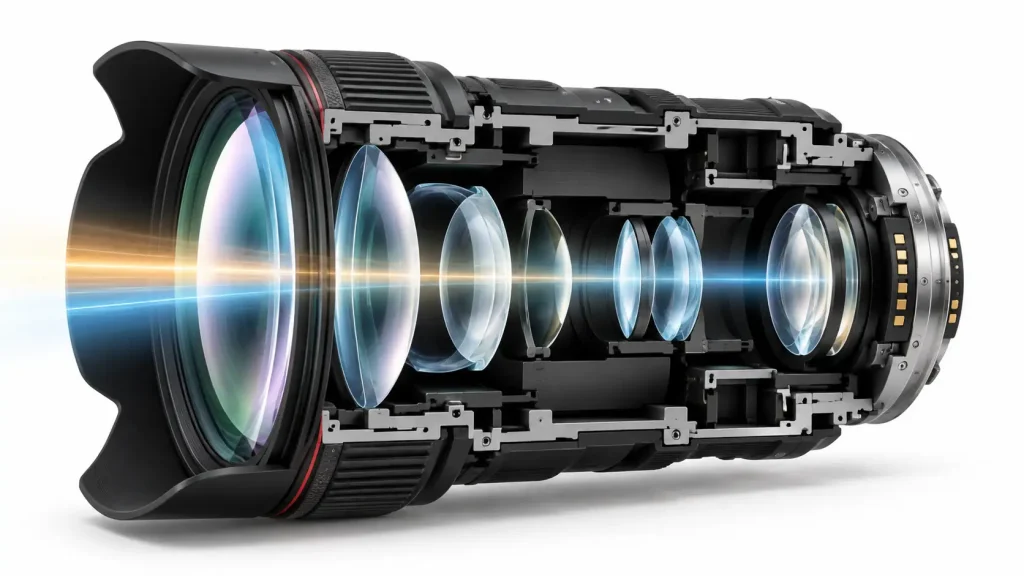
How camera lenses work comes down to light refraction. When light bounces off your subject, it scatters in all directions. The camera lens catches this scattered light. It then bends (refracts) the light through a series of curved glass pieces called “elements.”
These elements work together to focus the light into a sharp single point on the camera’s digital sensor. Modern lenses also include tiny motors to drive autofocus and moving glass elements to reduce shaky hands.
Understanding Key Lens Specifications
When you shop for a lens, you will see a jumble of numbers and letters on the box. You only need to understand two main specifications: focal length and aperture.
Focal Length
Focal length is measured in millimeters (mm). This number tells you how wide or how “zoomed in” the lens is.
-
Low numbers (e.g., 16mm or 24mm): Give you a very wide view. These are great for capturing big landscapes or tight indoor spaces.
-
High numbers (e.g., 200mm or 400mm): Give you a very narrow, magnified view. These bring distant objects closer, making them perfect for wildlife or sports.
Aperture
Aperture controls how much light the lens lets into the camera. It works just like the pupil in your eye. It opens wide in the dark and shrinks in bright light.
Aperture is measured in “f-stops,” written as f/1.8, f/2.8, or f/4. This math can be confusing, so just remember this simple rule:
-
A smaller number (like f/1.8): Means a wider opening. This lets in more light for night photography. It also creates a beautifully blurred background behind your subject.
-
A larger number (like f/8 or f/11): Means a smaller opening. This lets in less light, but it keeps both the foreground and background in sharp focus.
Prime vs Zoom: Which Is Better?
When deciding how to choose a lens, you must pick between two main styles: prime and zoom.
Zoom Lenses
A zoom lens offers a range of focal lengths, such as 24-70mm. You can zoom in and out by twisting the barrel.
-
Pros: Very versatile. You do not need to change lenses frequently. Great for travel and events.
-
Cons: They are usually heavier, larger, and let in less light than prime lenses.
Prime Lenses
A prime lens has a fixed focal length, such as 50mm. You cannot zoom in or out. If you want to get closer to your subject, you have to walk forward.
-
Pros: They are smaller, lighter, and usually much sharper. They also have wider apertures (like f/1.8), making them amazing for low light and blurry backgrounds.
-
Cons: Less versatile. You may need to carry two or three prime lenses to cover different situations.
Popular Types of Camera Lenses
Lenses are categorized by what they are designed to shoot. Here is a breakdown of the most common types.
Wide-Angle Lenses (14mm to 35mm)
Wide-angle lenses capture a massive field of view. They are the go-to choice for landscape photographers, real estate agents, and vloggers. Because they push the background away, they make small rooms look much bigger.
Standard Lenses (35mm to 70mm)
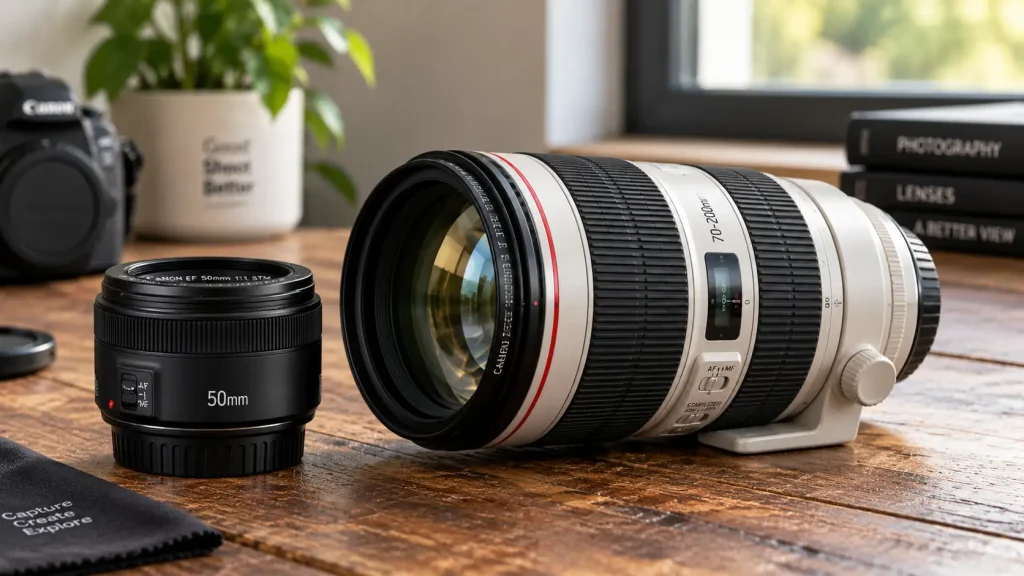
A standard lens sees the world very similarly to the human eye. They do not distort proportions. A 50mm standard lens (often called a “nifty fifty”) is usually the first upgrade a hobbyist makes.
Telephoto Lenses (70mm to 300mm+)
Telephoto lenses act like a telescope. They compress the distance, making objects in the background appear closer to your subject. These are mandatory for sports, birds, and wildlife photography.
Portrait Lenses (85mm to 135mm)
Portrait lenses are specialized prime lenses designed to flatter human faces. They offer zero distortion and usually feature very wide apertures. This combination melts the background into creamy, beautiful blur (called bokeh) so the person stands out perfectly.
Macro Lenses
A macro lens is a magnifying glass for your camera. It lets you get incredibly close to tiny subjects like insects, flowers, or wedding rings. True macro lenses reproduce the subject at life-size (a 1:1 ratio) on the camera sensor.
The Importance of Lens Mounts
You cannot attach just any lens to any camera. Every manufacturer uses a specific connection system called a lens mount.
For example, a Sony E-mount lens will not fit on a Canon RF-mount camera body. Before you buy, you must check your camera manual. When researching options, checking reliable gear databases like the DPReview lens buying guide will help you verify that a lens matches your exact mount.
You can sometimes use third-party adapters to mix and match brands. However, doing this often slows down autofocus speed. It is always best to buy a lens with the correct native lens mount.
Camera Lens Types Comparison
| Lens Type | Typical Focal Length | Best Used For | Key Advantage |
| Wide-Angle | 14mm – 35mm | Landscapes, Architecture, Vlogging | Captures massive scenes |
| Standard | 35mm – 70mm | Street photography, Everyday use | Matches human eye perspective |
| Portrait | 85mm – 135mm | Headshots, Weddings, Fashion | Flattering proportions, blurry backgrounds |
| Telephoto | 70mm – 300mm+ | Sports, Wildlife, Astrophotography | Reaches distant subjects easily |
| Macro | 60mm, 90mm, 105mm | Insects, Jewelry, Extreme close-ups | Extreme magnification |
How to Choose a Lens for Your Needs
Buying a lens is a big investment. Follow these numbered steps to make the right choice:
-
Identify your main subject: Are you shooting birds far away, or taking portraits of your family? Your subject dictates the focal length you need.
-
Check your lighting: Do you shoot indoors or at night? You will need a lens with a wide aperture, like f/1.8 or f/2.8.
-
Confirm your mount: Check your camera body to ensure you are buying a lens with the compatible mount.
-
Check for stabilization: If you shoot video or have shaky hands, look for lenses with built-in image stabilization. The Camera & Imaging Products Association (CIPA) sets the industry standard for how many “stops” of shake reduction a lens actually provides.
-
Set a budget: Good glass is expensive. Consider buying high-quality third-party brands like Sigma or Tamron if manufacturer lenses are too costly.
Expert Tips:
Do not sell your kit lens immediately. Spend a week taking photos with your standard 18-55mm kit lens. At the end of the week, look at your image files to see which focal length you used the most. If 90% of your favorite shots were taken at 50mm, you now know exactly which prime lens to buy!
When to Get Professional Help or a Second Opinion
Camera lenses are delicate precision instruments. While you can clean the outside glass yourself with a simple microfiber cloth, there are strict limits to DIY maintenance.
Get professional help if you notice:
-
Fungus inside the glass: If you see spiderweb-like growths inside the lens barrel, do not try to open the lens yourself. An authorized service center needs to safely dismantle and clean it to prevent the fungus from spreading to your camera body.
-
Grinding focus rings: If the zoom or focus ring feels gritty and tough to turn, sand or dirt has entered the gears. Forcing it will break the internal motors.
-
Focus calibration issues: If your camera beeps to say the subject is in focus, but the photo is blurry, the lens might be misaligned. Professional technicians use specialized software to recalibrate the focus.
Warning: Never unscrew the metal mount on the back of your lens. This exposes sensitive ribbon cables and delicate glass elements. Reassembling a lens requires a dust-free laboratory environment.
Common Mistakes Camera Buyers Should Avoid
-
Buying for the camera body, not the lens: Spending your entire budget on a camera and having nothing left for a good lens will ruin your photos.
-
Ignoring crop factor: If you have an APS-C (crop sensor) camera, a 50mm lens will act more like a 75mm lens. Always account for your sensor size.
-
Assuming zoom means better: Beginners often think a lens that zooms very far is automatically a “better” lens. In reality, prime lenses are usually much sharper.
-
Using cheap UV filters: Putting a $10 plastic UV filter on a $1,000 lens degrades your image quality instantly. If you use a protective filter, buy high-quality multi-coated glass.
-
Cleaning glass with clothing: Wiping your lens with your t-shirt can scratch the optical coating. Always use a dedicated air blower and a clean microfiber cloth.
FAQs
What is a camera lens used for?
A camera lens is used to gather scattered light from a scene and focus it cleanly onto the camera’s sensor. It allows you to control how much of the scene is visible and how bright the resulting image will be.
Can I use my camera without a lens?
No. If you take a photo without a lens attached, the camera sensor will only record a blurry, entirely white, or entirely black image. The sensor needs the glass elements to focus light into shapes.
Are all lenses compatible with all cameras?
No. Different camera brands (and even different camera lines within the same brand) use unique mounting systems. You must buy a lens that shares the exact same mount as your camera body, or use a specialized adapter.
What does “mm” mean on a camera lens?
The “mm” stands for millimeters and indicates the lens’s focal length. A lower number like 16mm gives a wide field of view, while a higher number like 200mm provides a magnified, zoomed-in view.
Why do some lenses cost more than the camera?
Premium lenses use expensive, specialized glass elements to eliminate color fringing and distortion. They also feature durable weather-sealing and fast, silent autofocus motors. Good glass holds its value for decades, long after a digital camera body becomes outdated.
Should a beginner buy a prime or zoom lens?
A beginner should ideally start with a standard zoom lens to discover their shooting style. Once you know what you like to shoot, buying a cheap 50mm prime lens is the best next step to learn about aperture and background blur.
Conclusion
Understanding what is a camera lens changes the way you look at photography. The lens is your camera’s window to the world. It dictates your lighting, your sharpness, and the creative mood of your background blur.
Remember that a great lens will outlive your camera body. Whether you choose a versatile zoom lens for family vacations or a fast prime lens for moody portraits, prioritize buying the best glass your budget allows.
Take a moment today to check which focal length you use the most on your current gear. Then, use the tips in this guide to confidently upgrade your camera bag and take your photography to the next level.

2 thoughts on “What Is a Camera Lens? How It Works & Which Type You Need”