
Rangefinder cameras hold a special place in the world of photography, combining vintage charm with remarkable precision. Long before digital and mirrorless systems dominated the market, rangefinders were the preferred tools of street photographers, photojournalists, and documentary creators.
Even today, these cameras remain popular for their sharp focusing system, compact design, and unique shooting experience that encourages photographers to slow down and truly connect with their subjects. Understanding what a rangefinder camera is and why it continues to attract enthusiasts is essential for anyone passionate about photography’s history, craftsmanship, and creative possibilities.
In this article, we’ll explore the definition, features, benefits, and modern relevance of rangefinder cameras to help you appreciate why they remain such a timeless choice for photographers around the world.
What is a rangefinder camera?
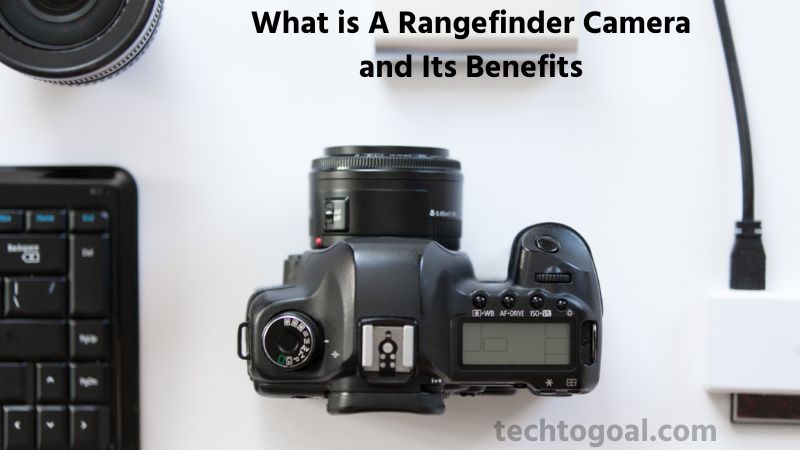
A rangefinder camera is a type of camera that uses a built-in range-finding focusing system to help photographers achieve precise manual focus. Instead of looking directly through the lens, the photographer looks through a separate optical viewfinder, which displays two overlapping images. By adjusting the focus ring on the lens, these images align perfectly, indicating that the subject is in sharp focus.
📌Read More👉 What is a digital camera?
Rangefinder cameras have a long and respected history in photography. They became widely popular in the mid-20th century and were the preferred tools of legendary street photographers, documentary storytellers, and photojournalists. Even today, many enthusiasts and professionals appreciate rangefinder cameras for their accuracy, simplicity, and classic shooting experience.
How Does a Rangefinder Camera Work?
A rangefinder camera uses a unique optical and mechanical system that allows photographers to focus with exceptional accuracy. Unlike SLR or mirrorless cameras, you don’t look through the main lens. Instead, you focus by aligning two images inside the viewfinder. Below is a detailed explanation based on the four core components of a rangefinder system:
Optical Mechanism: A rangefinder camera operates through a unique combination of optical precision and mechanical alignment, allowing photographers to focus with exceptional accuracy. At the core of this system is the optical mechanism, which uses two separate windows on the front of the camera, one for the main viewfinder and the other for the rangefinder.
Light entering these windows travels through mirrors and prisms, creating two slightly different views of the same scene inside the viewfinder. This difference in perspective is essential for achieving sharp focus.
Focusing System: The focusing system relies on aligning these two images. When you rotate the lens’s focus ring, a mechanical coupling shifts the angle of a prism or mirror inside the camera. This movement causes the secondary image in the viewfinder’s focusing patch to slide horizontally.
By turning the focus ring until both images perfectly overlap, you achieve precise manual focus. This method is especially effective for street photography and low-light shooting because it offers fast, reliable accuracy without depending on electronic autofocus.
Distance Measurement: Rangefinder cameras determine sharpness through distance measurement based on triangulation. The two windows are positioned a fixed distance apart, and each captures the subject from a slightly different angle.
When the images merge in the viewfinder, the camera has calculated the exact distance to the subject. This system ensures highly accurate focusing, even when shooting with wide apertures like f/1.4 or f/1.2, making it popular among portrait and documentary photographers.
Viewfinder Display: The viewfinder display of a rangefinder offers a bright, uninterrupted, and intuitive shooting experience. Inside the viewfinder, you’ll see illuminated frame lines that indicate the field of view for your lens, along with the central focusing patch where the double images appear.
Unlike SLRs, rangefinders do not use a mirror, so the viewfinder never blacks out during exposure. You also see beyond the frame lines, which helps anticipate movement entering the composition, an advantage that makes rangefinders a favorite for street and candid photography.
Overall, this combination of optical clarity, precise triangulation, and a distraction-free viewfinder makes the rangefinder system both distinctive and highly effective.
Benefits of Rangefinder Cameras
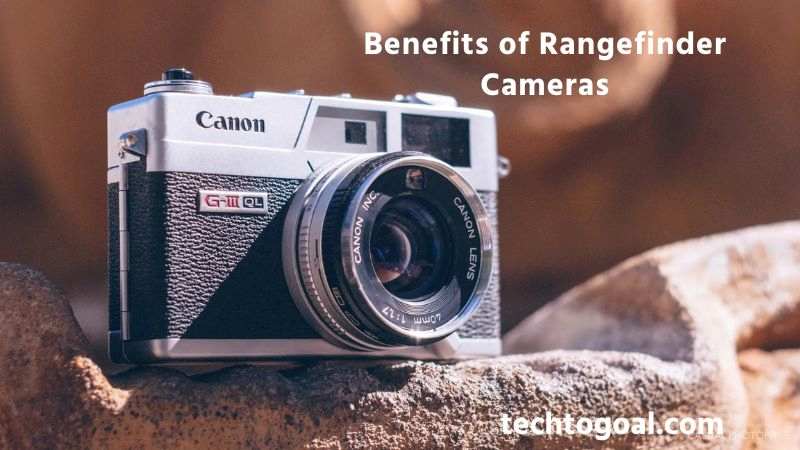
Rangefinder cameras may seem old-fashioned compared to modern DSLRs and mirrorless systems, but they offer unique advantages that continue to attract photographers worldwide.
📌Read More👉 Advantages of Digital Cameras
From precise manual focus to a distinctive shooting experience, rangefinders combine craftsmanship with performance in a way few cameras can match. Below are the key benefits explained in detail.
1. Accurate Focus
Rangefinder cameras are known for their exceptionally precise manual focusing system. The dual-image rangefinder mechanism allows photographers to match two overlapping images inside the viewfinder. When the images align perfectly, the subject is sharply in focus.
This system is especially accurate for wide-angle and standard lenses, making rangefinders a top choice for street, documentary, and portrait photography where sharpness matters most.
2. Rapid Focus
The rangefinder focusing method is not only accurate but also extremely fast. Because the focus is controlled by a clear, mechanical system, photographers can lock focus quickly even in low light. There’s no autofocus lag, hunting, or delay. With practice, focusing a rangefinder becomes almost instinctive, allowing you to capture decisive moments effortlessly.
3. Seeing Beyond the Frame
One of the most unique advantages of rangefinder cameras is the ability to see outside the frame lines in the viewfinder.
Since the viewfinder is separate from the lens, you can observe what’s happening around your subject, which is useful for:
- Anticipating movement
- Composing street shots
- Timing candid moments
- Tracking subjects entering or leaving the frame
This wider field of view gives photographers an extra level of awareness and control.
4. No Mirror
Rangefinders don’t use a mirror mechanism like DSLRs. This provides several benefits:
- Silent shutter operation, ideal for street or documentary work
- No viewfinder blackout, so you never lose sight of your subject
- Reduced vibration, resulting in sharper handheld shots
- More compact design, making the camera easier to carry
The absence of a mirror makes rangefinders smoother, quieter, and more reliable in fast-paced environments.
5. Prime Lenses
Rangefinder systems typically use compact, high-performance prime lenses. These lenses are known for:
- Exceptional optical quality
- Superb sharpness and contrast
- Fast apertures (f/1.4, f/1.2, even f/0.95)
- Lightweight and portable designs
Brands like Leica, Voigtländer, and Zeiss produce legendary M-mount lenses, often considered some of the best optics ever made.
6. Compact and Reliable
Rangefinders are celebrated for their compact size, solid build, and long-term durability. Without complex mirror assemblies or bulky housings, they are lighter and more travel-friendly than most professional DSLRs.
Their simple mechanical structure also makes them more reliable in the long run—many vintage rangefinders from the 1950s and 60s still function perfectly today.
7. Different Shooting Experience
Above all, rangefinder cameras offer a unique, mindful, and intentional shooting experience. Photographers often describe using a rangefinder as
- More connected to the scene
- Less distracted by settings or screens
- Encouraging slower, more thoughtful composition
- Feeling like working with a precision instrument rather than a gadget
This distinctive experience is one of the main reasons photographers fall in love with rangefinders, even in a digital age.
Rangefinder cameras may not be as feature-packed as modern mirrorless systems, but their precision, simplicity, and shooting style make them timeless tools. Whether you’re a street photographer, documentary storyteller, or simply someone who appreciates fine craftsmanship, rangefinders offer a refreshing and rewarding way to approach photography.
Drawbacks of Rangefinder Cameras
Unfortunately, no camera is flawless, which is why owning or practicing with a variety of cameras is prudent and enjoyable. Of course, not everyone should use a rangefinder. They can be annoying. They have limitations, just like any other tool. Your photography can undoubtedly be limited by rangefinders. How?
1. Parallax Error
One of the most significant limitations of rangefinder cameras is parallax error, a focusing and framing issue that occurs because the photographer is not looking through the actual lens. Instead, the viewfinder is positioned slightly to the side of the lens, creating a difference in perspective. While this may seem minor, it becomes a serious problem when shooting close subjects, portraits, or macro-like compositions.
At short distances, the camera “sees” the scene differently from what the lens captures, leading to inaccurate framing. Subjects may appear off-center, edges may get unintentionally cropped, and compositions may not match what you saw in the viewfinder.
Even though many rangefinder cameras include parallax-correcting frame lines, they cannot completely eliminate this issue. The closer you get to the subject, the more noticeable the error becomes.
This makes rangefinders less ideal for close-up photography, product shots, or any genre that requires precise composition. Photographers must learn to compensate manually, which can be frustrating for beginners and time-consuming in fast-paced environments.
2. Difficult and Challenging
Rangefinder cameras offer excellent focusing accuracy, but they are also not beginner-friendly. The focusing mechanism requires you to manually align two images in the viewfinder, something that demands patience, good eyesight, and practice.
This can be especially challenging in low light, where the rangefinder patch becomes dim or hard to see. Unlike modern cameras with autofocus, focus peaking, or electronic aids, rangefinders rely entirely on manual skill.
Additionally, rangefinders do not support long telephoto lenses, macro lenses, or zoom lenses effectively. The viewfinder is optimized for moderate focal lengths, making certain types of photography, such as sports, wildlife, and close-up work, difficult or almost impossible.
Composing through a viewfinder that does not match the lens’s actual perspective adds another layer of complexity, especially when switching between lenses.
The shooting experience itself is also quite different. Because you don’t look through the lens, you can’t preview depth of field, bokeh quality, or the exact framing. Many photographers love this simplicity, but for others, especially those used to DSLR or mirrorless systems, it can feel restrictive and confusing.
Overall, rangefinder cameras require more time to master, making them challenging tools for anyone who needs quick results or relies on modern automation.
Choosing a Rangefinder Camera
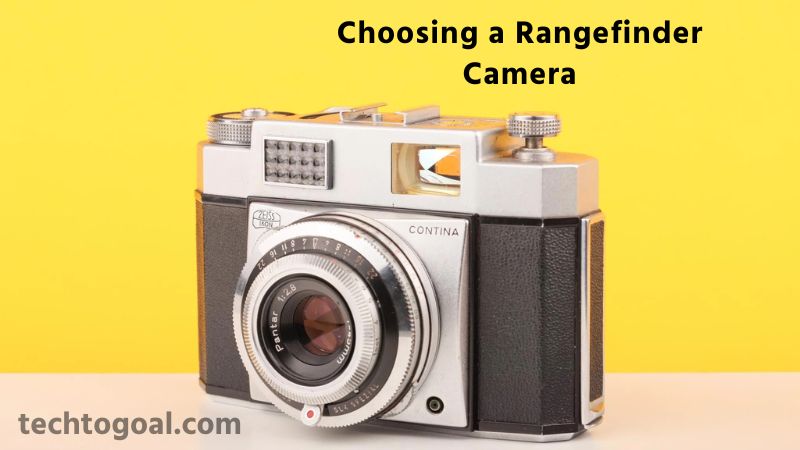
Choosing a rangefinder camera is rewarding but different from buying a mirrorless or DSLR. Because rangefinders prioritize build, lens ecosystem, and a particular shooting experience, your buying decision should weigh long-term value more than specs alone.
📌Read More👉 How to Clean Camera Sensor
Below is an in-depth, human-written guide focused on the four key factors you listed: Price, features, size, and reviews are each explained with practical advice and purchase checklists.
1. Price—Understand Total Cost, Not Just the Body
Price is often the first filter, but with rangefinders you must consider the total cost of ownership. Classic film rangefinders can be affordable, but high-quality vintage models may need servicing. Modern digital rangefinders command premium prices for the body and lenses. When evaluating price, include these hidden costs:
- Lenses: Rangefinder lenses, especially fast primes, are where most money is spent. A small, high-quality 35mm or 50mm lens can cost as much (or more) than the camera body.
- Servicing & Calibration: Older mechanical rangefinders may need CLA (clean, lubricate, adjust) work to keep the rangefinder coupling accurate. Budget for maintenance if buying vintage.
- Accessories: Filters, dedicated viewfinder accessories, spare batteries, and protective cases add up.
- Resale Value: Some rangefinder systems retain value well. Consider depreciation if you plan to upgrade or resell.
Buying tip: Set a realistic budget split (e.g., 40% body, 60% lenses + accessories) and prioritize lens quality over a marginally newer body. If on a tight budget, consider well-serviced used bodies with one strong prime lens.
2. Features—Match Capabilities to Your Shooting Style
Rangefinders are intentionally minimalist, but different models offer different features. Decide which features are essential for your photography and which you can live without:
- Focusing & Rangefinder Coupling: Check for accurate coupling across focal lengths. Some vintage cameras have weaker coupling for very wide or long lenses. Digital rangefinders may include frameline selection and improved accuracy.
- Viewfinder Brightness & Framelines: Look for clear, bright framelines and easy lens/frame selection. Multiframe viewfinders (automatic frameline selection) are highly convenient.
- Metering & Exposure Controls: Do you want spot metering, TTL metering, or manual-only exposure? Film rangefinders often require external meters or handheld light meters; many modern digital M-style cameras include built-in metering.
- Shutter Options: Check for top shutter speeds, flash sync speed, and whether the shutter is mechanical or electronic. Mechanical shutters are valuable for reliability and working without power.
- Digital Features: For digital rangefinders, consider sensor resolution, ISO performance, live view availability, and video (if any). Some purists prefer minimal digital features to maintain the classic experience.
Buying tip: Create a “must-have / nice-to-have” feature list. If you shoot street and documentary work, prioritize a bright viewfinder, quiet operation, and compact primes; if you shoot portraits, prioritize fast lenses and accurate coupling at short distances.
3. Size—Portability vs. Handling
One of the rangefinder’s great strengths is compactness, but size affects ergonomics and shooting style:
- Compact Bodies: Rangefinders are generally smaller and lighter than SLRs, making them ideal for travel and street photography. Small bodies pair best with compact primes.
- Grip & Controls: Tiny bodies can be harder to hold for long sessions. Check whether the camera has a comfortable grip, accessible controls, and logical layout, especially if you shoot handheld a lot.
- Lens Size & Balance: A compact body can become front-heavy with large, fast lenses, changing the handling. Try to balance the camera with the typical lens you’ll use most.
- Portability Trade-offs: Smaller cameras are less obtrusive for candid work, but if you require battery grips, large viewfinder accessories, or longer lenses, the advantage diminishes.
Buying tip: If possible, physically handle the camera (or watch close-up handling videos) to test balance with your preferred lens. Prioritize a rig you’ll actually carry—comfort encourages more shooting.
4. Reviews—Read Deep, Not Just Star Ratings
Reviews are essential, but smart reading separates marketing hype from real-world performance:
- Technical Reviews: Look for reviewers who test rangefinder coupling accuracy, parallax correction, and viewfinder clarity. Technical measurements matter more than glossy photos.
- User Reviews & Forums: Long-term user reports reveal reliability issues, service histories, and common quirks. Forum threads can show how easy a model is to service and what to expect from used examples.
- Video Reviews & Handling Tests: Seeing the camera in the reviewer’s hands reveals ergonomics, menu systems, and how well the camera pairs with lenses. For vintage gear, look for CLA demonstrations and sample images.
- Sample Image Analysis: Study full-size photos for real-world sharpness, micro-contrast, and bokeh from typical lenses. Beware of sample bias: some reviewers use optimized lenses or careful lab conditions.
- Serviceability & Parts Availability: Reviews or forum posts that discuss repairs, parts scarcity, and authorized service centers are especially important for older mechanical models.
Buying tip: Cross-check at least three types of sources: professional reviews, in-depth forum threads, and user gallery samples. If buying used, ask the seller for service history and test the rangefinder alignment in person or request proof of recent CLA.
Choosing a rangefinder camera is as much about the experience as it is about specs. Think beyond headline features; consider lens costs, long-term maintenance, ergonomics, and community knowledge. Prioritize lenses and handling over a slightly newer body, and use deep reviews to reveal real-world strengths and pitfalls.
With the right balance of price, features, size, and informed review research, you’ll find a rangefinder that not only takes beautiful photos but also changes how you see and make them.
A Brief History of Rangefinder Cameras
The history of rangefinder cameras dates back to the early 20th century, playing a major role in shaping modern photography. These cameras were first introduced as a solution to achieve more accurate focusing than early box and folding cameras could provide. Their innovative dual-image focusing system quickly made them a favorite among serious photographers.
Early Beginnings (1910s–1920s): The first rangefinder mechanisms appeared in the 1910s, primarily as separate accessories mounted on cameras. They helped photographers measure subject distance for sharper manual focus. However, these early systems were not yet integrated into the camera body.
Rise of the Modern Rangefinder (1925): The true evolution began in 1925 with the launch of the Leica I, designed by Oskar Barnack. Leica combined portability, a fast lens system, and a compact body, marking the beginning of modern 35mm photography. By the late 1920s and early 1930s, integrated rangefinder mechanisms became standard in high-end cameras.
Golden Age of Rangefinders (1930s–1960s): Between the 1930s and 1960s, rangefinder cameras reached peak popularity. Brands like Leica, Contax, Canon, and Nikon produced advanced models with bright viewfinders, interchangeable lenses, and improved durability. Photojournalists and street photographers embraced rangefinders because they were quieter, lighter, and faster to operate compared to early SLRs.
During this period, many iconic images in history—war coverage, street scenes, and documentary works were captured using rangefinder cameras.
Competition from SLRs (1960s–1980s): By the late 1960s, single-lens reflex (SLR) cameras gained dominance due to their through-the-lens viewing system, which offered more accurate framing and compatibility with telephoto lenses. This shift caused rangefinders to decline in mainstream popularity, though they remained beloved among enthusiasts.
The Revival and Digital Era (2000s–Present): The introduction of the Leica M8 in 2006 marked the world’s first digital rangefinder camera, reigniting interest among professionals and collectors. Today, digital rangefinders like the Leica M10, M11, and various film-based models continue to be treasured for their craftsmanship, simplicity, and unmatched manual focusing experience.
Why This History Matters
The evolution of rangefinder cameras reflects the growth of photography itself—from compact 35mm beginnings to modern digital innovation. Understanding this history helps photographers appreciate why rangefinders remain a unique and timeless choice even in the age of mirrorless and smartphone cameras.
FAQs
How does a rangefinder camera differ from an SLR?
Unlike an SLR, a rangefinder does not use a mirror system, and you don’t look through the lens when composing a shot. This makes rangefinders quieter, smaller, and often faster for focusing, but less accurate for close-up compositions.
Why do photographers still use rangefinder cameras?
Photographers love rangefinders for their sharp manual focus, compact size, bright viewfinder, and the ability to see outside the frame. They’re popular for street, travel, and documentary photography.
Are rangefinder cameras difficult to learn?
Yes, rangefinders take time to master. You need to manually align two images to focus, which can be challenging for beginners or in low-light situations. However, with practice, the process becomes fast and intuitive.
What types of photography are rangefinders best for?
Rangefinder cameras excel in street, travel, reportage, and documentary photography because of their fast focusing, compact design, and framelines that allow photographers to anticipate movement.
Can you use zoom lenses on a rangefinder camera?
Most rangefinder systems do not support zoom lenses. They are primarily designed for compact prime lenses, which offer better optical performance and smoother manual focusing.
Do rangefinder cameras have parallax error?
Yes. Because the viewfinder is offset from the lens, close subjects may appear misaligned or slightly shifted. Many cameras feature parallax-correcting frame lines, but the issue cannot be fully eliminated.
Are digital rangefinder cameras available today?
Yes. Modern brands like Leica produce digital rangefinder cameras with high-resolution sensors, advanced metering, and compatibility with classic M-mount lenses.
Is a rangefinder camera good for beginners?
A beginner can use a rangefinder, but it may feel challenging at first. These cameras require manual focusing and understanding of composition without TTL (through-the-lens) preview. However, for those willing to learn, a rangefinder offers a rewarding and creative shooting experience.
Conclusion
A photographer might enjoy simplicity, difficulty, constraints, and enjoyment when using a rangefinder camera. They may be the love-hate camera. Despite detractors, the rangefinder is adored for a number of reasons, including its innovative focusing technology and traditional approach to shooting.
Rangefinder cameras are a timeless symbol of precision, craftsmanship, and the art of mindful photography. By using a dual-window optical system for accurate manual focus, these cameras offer a unique shooting experience that differs from modern DSLRs and mirrorless cameras.
They excel in street, travel, and documentary photography due to their compact size, quiet operation, fast focusing, and ability to see beyond the frame. While they have limitations such as parallax error and the learning curve for beginners, the rewards are significant.